


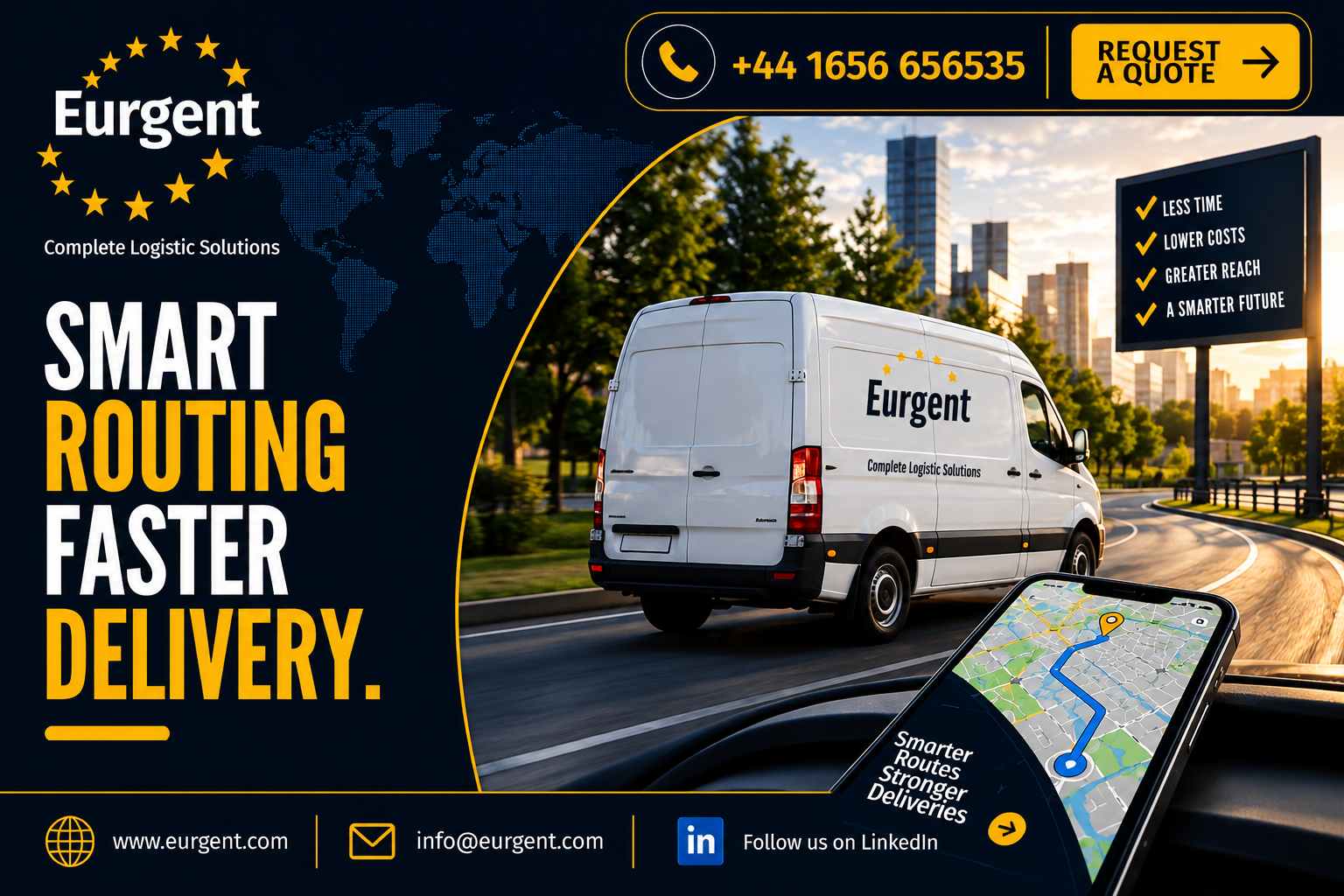
In modern logistics, getting a shipment from one location to another is only part of the challenge. Businesses also need to deliver efficiently, control transport costs, respond to changing conditions and provide customers with a dependable service.
Smart routing brings these priorities together. By planning more efficient journeys and making better use of available transport resources, logistics providers can reduce unnecessary mileage, improve delivery performance and build stronger, more scalable operations.
At Eurgent Complete Logistic Solutions, effective route planning forms part of a wider commitment to reliable, responsive and efficient logistics.
What Is Smart Routing in Logistics?
Smart routing is the process of selecting efficient delivery routes using more than simply the shortest distance between two points. A strong routing strategy considers the practical factors that influence whether a delivery can actually be completed efficiently.
Depending on the operation, these factors may include:
- Delivery locations and time requirements
- Distance between collection and delivery points
- Road conditions and likely congestion
- Vehicle availability and capacity
- Multiple collections or delivery stops
- Customer priorities
- Driver schedules
- Operational restrictions
- Fuel and mileage efficiency
- Unexpected delays or route changes
The objective is simple: use smarter routes to create stronger deliveries.
Why Route Planning Matters More Than Ever
Customer expectations around delivery have changed dramatically. Businesses increasingly expect logistics partners to provide speed, flexibility and reliability while keeping transportation commercially sensible.
Poor routing can create problems throughout the supply chain. An inefficient journey may add only a small amount of unnecessary mileage to one delivery, but repeated across hundreds or thousands of movements, those inefficiencies can become significant.
Better routing can help logistics operations work towards four important outcomes:
| Routing Goal | Potential Business Benefit |
|---|---|
| Less Time | Reduce unnecessary travel and improve delivery efficiency. |
| Lower Costs | Better mileage and resource utilisation can help control transport expenditure. |
| Greater Reach | Efficient planning can help businesses manage broader and more complex delivery networks. |
| A Smarter Future | Data-led logistics creates opportunities for continuous operational improvement. |
1. Faster Deliveries Through Better Planning
Speed in logistics does not simply come from driving faster. In many cases, the biggest improvements come from planning better before the vehicle begins its journey.
A well-planned route can reduce unnecessary detours, repeated journeys and inefficient stop sequences. When several deliveries need to be completed, the order in which those stops are approached can make a major difference to overall journey time.
Effective routing helps logistics teams answer practical questions such as:
- Which vehicle is best positioned for the job?
- What is the most efficient sequence of stops?
- Can several deliveries be coordinated into one journey?
- Are there known delays that should be avoided?
- Does the route support the required delivery window?
- Is an alternative route likely to provide greater reliability?
Answering these questions before and during transportation can make delivery operations significantly more organised.
2. Lower Transport Costs
Every unnecessary mile has a cost. Fuel, driver time, vehicle utilisation and general operating expenses can all increase when journeys are poorly planned.
Smart routing aims to remove avoidable inefficiency.
For example, if several deliveries are located within the same geographical area, intelligent planning can help organise them into a logical sequence rather than treating each movement independently.
This can support:
- Reduced unnecessary mileage
- More productive driver hours
- Better use of available vehicles
- Fewer inefficient journeys
- Improved delivery density
- More predictable operating costs
The result is not simply a shorter route. It is a more commercially efficient logistics operation.
3. More Reliable Delivery Performance
Customers remember reliability. A business may offer an excellent product, but repeated delivery delays can quickly damage the overall customer experience.
Good route planning helps logistics teams create more realistic and dependable delivery schedules. Rather than relying on assumptions, planners can consider distance, route complexity, delivery windows and operational constraints before committing resources.
Reliable logistics is built on good decisions before the journey begins.
Greater predictability also benefits internal teams because customer service, warehouse staff, drivers and clients can work around clearer expectations.
4. Better Vehicle Utilisation
A successful logistics operation needs to make effective use of its transport capacity. Sending the wrong vehicle, creating unnecessary journeys or leaving available capacity unused can increase operating costs.
Routing and vehicle planning should therefore work together.
Before allocating a movement, logistics teams may need to consider:
- Shipment size
- Shipment weight
- Collection requirements
- Delivery destination
- Vehicle capacity
- Urgency
- Additional stops
- Future collections near the destination
Matching the right vehicle with the right journey can improve efficiency across the entire network.
5. Smart Routing Supports Multi-Stop Deliveries
Routing becomes even more important when a vehicle has multiple collections or deliveries.
Consider a vehicle with six deliveries. Visiting those locations in the wrong order could create unnecessary backtracking, longer mileage and missed delivery windows. An intelligently sequenced route aims to minimise those problems.
| Traditional Approach | Smarter Routing Approach |
|---|---|
| Stops handled individually | Stops considered as one coordinated journey |
| Greater chance of backtracking | Logical stop sequencing |
| More unnecessary mileage | Focus on efficient mileage |
| Reactive decisions | Planned and adaptable decisions |
This becomes increasingly valuable as delivery volumes and geographical coverage grow.
6. Route Optimisation and Customer Experience
Routing may happen behind the scenes, but customers experience its results directly.
Efficient planning can contribute to:
- More dependable delivery times
- Fewer avoidable delays
- Better communication
- Greater confidence in delivery commitments
- More consistent service
For businesses relying on logistics to serve their own customers, this reliability can become an important competitive advantage.
7. Adapting When Conditions Change
No route remains perfect simply because it looked efficient at the start of the day. Logistics operates in a changing environment.
Traffic congestion, road closures, weather, delays at collection points and changing customer requirements can all affect the original plan.
That is why modern route management needs flexibility as well as planning.
A responsive logistics operation should be able to:
- Identify when the original route is no longer efficient
- Evaluate practical alternatives
- Reprioritise deliveries when necessary
- Communicate changes appropriately
- Protect important delivery commitments wherever possible
The ability to adapt can be just as important as selecting the original route.
8. Smarter Routing and Business Growth
Routing efficiency becomes increasingly important as a company grows.
Managing ten deliveries is very different from coordinating hundreds of collections and deliveries across multiple areas. Without effective systems and processes, increasing volume can also increase complexity.
Smart logistics planning can help create a stronger operational foundation for growth by making it easier to coordinate:
- More customers
- More delivery locations
- More vehicles
- More frequent collections
- Wider geographical coverage
- More complex delivery requirements
In other words, efficiency helps create scalability.
9. The Role of Data in Smarter Logistics
Good logistics decisions become stronger when businesses can learn from previous operations.
Historical journey information can help identify recurring patterns such as areas where delays regularly occur, routes that consistently take longer than expected or delivery windows that require additional planning.
Useful operational indicators may include:
- Average delivery time
- Mileage per delivery
- Vehicle utilisation
- On-time delivery performance
- Failed or delayed deliveries
- Average time per stop
- Recurring congestion points
- Cost per movement
Over time, this information can support better planning and continuous improvement.
10. Smart Routing and More Sustainable Logistics
Efficiency and sustainability often move in the same direction.
If a logistics provider can complete the required work using fewer unnecessary miles, better vehicle utilisation and more coordinated journeys, it can reduce avoidable fuel consumption at the same time.
Route optimisation can therefore contribute to sustainability efforts through:
- Reduced unnecessary journeys
- Lower avoidable mileage
- Improved load and vehicle utilisation
- More coordinated delivery schedules
- Greater operational efficiency
The most sustainable mile is often the unnecessary mile that never needs to be driven.
What Makes an Effective Routing Strategy?
There is no single route-planning method that works for every logistics operation. The right strategy depends on shipment requirements, customers, geography and available resources.
However, an effective approach usually combines several principles:
- Plan around customer requirements. Delivery windows and priorities should be understood from the beginning.
- Consider the entire journey. Focus on overall efficiency rather than individual road segments.
- Match vehicles appropriately. Vehicle selection should support the shipment and route.
- Minimise unnecessary mileage. Avoid repeated routes and inefficient backtracking wherever practical.
- Build flexibility into the plan. Conditions can change, so operations need the ability to respond.
- Review performance. Previous journeys can reveal opportunities for future improvement.
Smart Routing vs Simply Choosing the Shortest Route
One of the most important distinctions is that the shortest route is not automatically the smartest route.
| Shortest Route | Smart Route |
|---|---|
| Primarily considers distance | Considers the overall delivery objective |
| May overlook congestion | Can account for likely delays |
| May not suit multiple stops | Can optimise stop sequencing |
| Limited operational context | Considers vehicles, customers and resources |
| Distance focused | Performance focused |
A route that is slightly longer in distance may sometimes be faster, more reliable or more commercially sensible once real operational conditions are considered.
Why Businesses Need the Right Logistics Partner
For many companies, transportation is not simply an operational expense. It directly affects customer satisfaction, inventory movement, supply chain continuity and business reputation.
The right logistics partner should therefore provide more than transportation from A to B. Businesses need an approach built around organisation, communication, reliability and practical problem solving.
Eurgent Complete Logistic Solutions focuses on helping customers move goods through efficient and dependable logistics solutions, with planning designed around the requirements of each movement.
Key Benefits of Smarter Routing at a Glance
| Benefit | Why It Matters |
|---|---|
| Faster Journeys | Less unnecessary travel can improve overall delivery speed. |
| Lower Mileage | Helps control fuel and operating costs. |
| Better Reliability | Supports more dependable delivery planning. |
| Improved Capacity | Available vehicles and driver time can be used more effectively. |
| Better Customer Experience | Reliable logistics strengthens customer confidence. |
| Scalable Operations | Efficient processes help businesses manage increasing delivery demand. |
Frequently Asked Questions
What is route optimisation in logistics?
Route optimisation is the process of planning efficient journeys for vehicles and deliveries while considering factors such as locations, time requirements, vehicle availability, stop sequences and operational constraints.
Is the shortest route always the fastest?
No. A shorter route may include congestion, restrictions or other delays. Effective routing considers the overall journey rather than distance alone.
Can smart routing reduce logistics costs?
Efficient routing can help reduce unnecessary mileage, improve vehicle utilisation and make better use of driver time, all of which can support better cost control.
How does route planning improve customer service?
Better planning can support more dependable delivery schedules, fewer avoidable delays and clearer expectations for customers.
Why is route optimisation important for growing businesses?
As delivery volumes increase, transport networks become more complex. Structured routing helps businesses manage that complexity and use available resources more efficiently.
Can routing help reduce environmental impact?
Reducing unnecessary mileage and improving vehicle utilisation can help decrease avoidable fuel consumption, making operational efficiency relevant to sustainability as well as cost.
Smarter Routes. Stronger Deliveries.
Successful logistics is not only about moving quickly. It is about moving intelligently.
From selecting suitable routes and coordinating multiple stops to making better use of vehicles and responding to changing conditions, smarter planning can strengthen almost every stage of a delivery operation.
For businesses, the advantages can extend far beyond transportation: less wasted time, better cost control, greater reliability, stronger customer experiences and a logistics operation that is better prepared for future growth.
That is the value of smart routing — making every journey work harder for the business behind it.
Need a Reliable Logistics Solution?
Whether you need dependable transportation, efficient delivery planning or support for your wider logistics requirements, Eurgent Complete Logistic Solutions is ready to help.
Call: +44 1656 656535
Email: info@eurgent.com
Website: www.eurgent.com
Request a quote today and discover how smarter logistics can support stronger deliveries.