


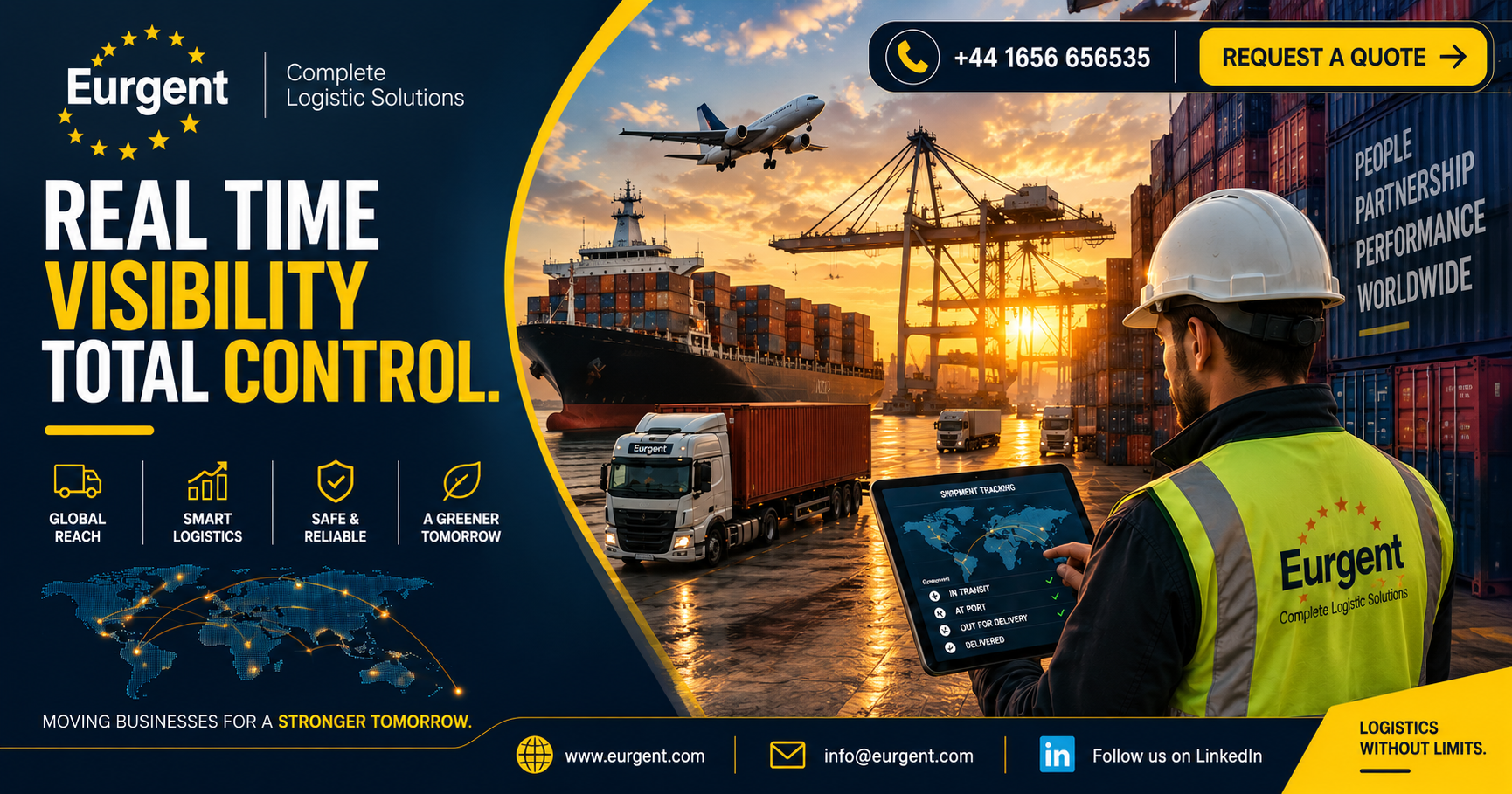
Modern logistics is about more than moving goods from one location to another. Businesses also need to know what is happening throughout the journey.
When important freight is moving between suppliers, ports, warehouses and customers, uncertainty can create operational problems. Teams need accurate information to plan production, coordinate deliveries, manage inventory and keep customers informed.
That is why real-time logistics visibility has become increasingly important.
At Eurgent, complete logistics solutions are built around effective coordination, communication and control. Greater visibility across freight movements can help businesses understand shipment progress, respond more effectively when circumstances change and make better-informed supply chain decisions.
Real-time visibility. Total control.
What Is Real-Time Logistics Visibility?
Real-time logistics visibility refers to the ability to access timely information about freight as it moves through the supply chain.
Rather than treating a shipment as something that disappears after collection and reappears at delivery, visibility provides businesses with information about its progress through important stages of the journey.
Depending on the transport operation and systems involved, shipment information can help teams understand stages such as:
- Collection and dispatch
- Freight in transit
- Arrival at ports, terminals or logistics facilities
- International transportation
- Onward distribution
- Out-for-delivery status
- Final delivery
The objective is not simply to generate more data. Useful logistics visibility provides relevant information that helps businesses make decisions.
Why Supply Chain Visibility Matters
A shipment rarely affects only the logistics department.
Incoming materials can influence production schedules. Delayed inventory can affect sales. Delivery information may be needed by customer-service teams. Warehouses need to know when goods are expected so that they can plan resources appropriately.
When shipment information is unclear, uncertainty can spread across the organisation.
Greater supply chain visibility can support:
- Better operational planning
- More informed inventory decisions
- Clearer customer communication
- Faster identification of potential disruption
- Better coordination between suppliers and logistics partners
- More efficient warehouse planning
- Improved decision-making across the business
Visibility turns logistics information into something the wider business can use.
From Shipment Tracking to Supply Chain Control
Tracking tells you where a shipment is. Control comes from knowing what to do with that information.
This distinction is important.
A location update may be useful, but businesses often need more context. Has the shipment reached the expected stage? Is the planned delivery still achievable? Does another team need to take action? Is there an alternative solution if circumstances have changed?
Effective visibility therefore combines shipment information with communication and operational expertise.
This allows businesses to move from simply observing freight movements towards actively managing their supply chains.
Why Traditional Shipment Updates Can Create Problems
In less connected logistics environments, information can become fragmented across emails, telephone calls, spreadsheets and multiple transport providers.
A team may need to contact several parties simply to understand the current status of one important movement.
This can create several challenges:
- Information may arrive too late to support effective action.
- Different teams may be working from different updates.
- Employees can spend unnecessary time chasing shipment information.
- Customers may receive inconsistent answers.
- Potential disruptions may not be identified early enough.
Better logistics visibility aims to reduce these information gaps and create a clearer picture of freight movements.
Real-Time Visibility Supports Better Decision-Making
Supply chain decisions are only as useful as the information behind them.
Consider a business waiting for important materials. If the team believes those materials will arrive on Tuesday, it may schedule employees, production and onward deliveries around that expectation.
If circumstances change but the business does not discover this until Tuesday afternoon, the consequences may extend far beyond the shipment itself.
Earlier visibility can provide more time to respond.
The organisation might adjust a production schedule, communicate with a customer, reorganise warehouse resources or investigate an alternative solution.
Visibility cannot eliminate every logistics disruption, but better information can improve the quality and timing of the response.
Visibility Across Road Freight
Road transport is a vital part of many supply chains, whether goods are moving directly between businesses or connecting with airports, ports and distribution facilities.
Visibility across road freight can help organisations understand the progress of collections and deliveries while coordinating activities at either end of the journey.
Relevant information can support:
- Collection planning
- Delivery scheduling
- Warehouse preparation
- Customer communication
- Coordination with onward transport
For multimodal movements, road freight visibility is particularly valuable because delays during the first or final stage can influence the wider shipment.
Visibility Across Air Freight
Air freight is often selected when transit time is particularly important. That makes timely information equally important.
An air freight movement may involve much more than the flight itself. Goods may need to be collected, transported to the airport, processed, flown internationally and then transferred to onward transportation.
Visibility across these stages helps businesses understand the complete journey rather than focusing only on the aircraft movement.
For urgent freight, this wider perspective can be essential to effective planning.
Visibility Across Sea Freight
Sea freight is a fundamental part of international supply chains, particularly for containerised cargo and larger freight volumes.
Longer journeys and multiple handover points can make effective communication especially important.
Businesses may need information relating to:
- Origin transportation
- Port arrival
- Vessel movement
- Destination arrival
- Terminal activity
- Onward road transportation
- Final delivery
Understanding how these stages connect can help organisations plan inventory, warehouse capacity and customer commitments more effectively.
Multimodal Logistics Needs Connected Visibility
Many international shipments use more than one mode of transport.
A container might leave a supplier by road, travel internationally by sea and then complete its journey by truck. An urgent shipment could be collected by vehicle, transferred through an airport and delivered by road after landing.
Managing each stage independently can make it difficult to understand the complete journey.
A more connected approach considers the shipment from origin to destination.
This is particularly valuable at transfer points, where the performance of one stage can directly influence the next.
Visibility Helps Businesses Manage Exceptions
Most businesses would prefer every shipment to follow its original schedule perfectly. In reality, logistics operates in a dynamic environment.
Freight can be affected by factors including:
- Weather conditions
- Traffic and congestion
- Port or terminal disruption
- Transport capacity
- Operational changes
- Infrastructure issues
- Changes in customer requirements
The real value of visibility often becomes apparent when something does not go according to plan.
Early awareness can give logistics teams and customers more time to understand the situation and evaluate the available options.
Proactive Logistics Instead of Reactive Logistics
There is a significant difference between discovering a problem after it has affected operations and identifying a potential issue early enough to respond.
Reactive logistics focuses on dealing with problems after they become urgent.
A more proactive approach uses information, communication and planning to identify issues earlier and consider appropriate actions.
For example, if a potential delay becomes visible early, a business may be able to:
- Adjust internal schedules
- Inform customers in advance
- Review alternative transport options
- Reallocate inventory
- Change warehouse arrangements
- Coordinate other parts of the supply chain
This does not mean every problem can be prevented. It means businesses can be better prepared to respond.
Better Visibility Can Improve Customer Communication
Customers increasingly expect useful information about their orders and deliveries.
When a business lacks visibility into its own logistics operation, customer-service teams can struggle to provide confident answers.
They may need to contact operations, wait for an update from a carrier and then return to the customer later.
Better shipment information can create a more efficient communication process.
Even when a delivery has been affected by an unexpected event, providing a clear and timely update can be considerably better than leaving the customer without information.
Supply Chain Visibility and Inventory Management
Inventory decisions are closely connected to logistics.
If businesses do not have confidence in inbound shipment information, they may compensate by carrying additional stock or creating larger buffers.
Greater visibility can provide planning teams with better information about incoming goods.
This does not automatically eliminate the need for safety stock, but it can help organisations make inventory decisions using a clearer understanding of what is moving through the supply chain.
Supporting More Efficient Warehousing
Warehouses depend on timing.
Teams need to plan receiving activity, allocate space, schedule employees and prepare goods for onward distribution.
If multiple shipments arrive unexpectedly at the same time, operations can become more difficult. If an expected shipment does not arrive, resources may have been allocated unnecessarily.
Improved logistics visibility can support better coordination between transportation and warehouse operations.
This creates a more connected supply chain in which information moves alongside the freight.
Technology Is Changing Logistics Visibility
Digital technology has significantly expanded the amount of logistics information businesses can access.
Tracking platforms, connected systems, transport-management technology and digital communications can all contribute to a more transparent supply chain.
Technology can potentially help organisations:
- Monitor shipment progress
- Centralise logistics information
- Reduce manual status checking
- Share relevant updates with stakeholders
- Analyse historical transport performance
- Identify patterns and recurring issues
However, technology alone does not create an effective logistics operation.
Systems still need reliable information, appropriate processes and experienced people who understand how to interpret and act on what they see.
People, Technology and Logistics Expertise
The strongest logistics operations combine technology with human expertise.
A digital platform may indicate that a shipment has been delayed, but an experienced logistics professional can help interpret what that means for the customer’s wider requirements.
They can consider questions such as:
- How significant is the delay?
- Which customer operations could be affected?
- Does anyone need to be informed immediately?
- Are alternative arrangements available?
- What is the most practical next step?
Technology provides visibility. People turn visibility into action.
Real-Time Visibility and Supply Chain Resilience
Resilient supply chains are not those that never experience disruption. They are supply chains capable of understanding problems and responding effectively when conditions change.
Visibility supports resilience by improving awareness.
If businesses understand what is happening across important freight movements, they can assess risks earlier and coordinate a more informed response.
Over time, logistics data can also help organisations identify recurring vulnerabilities.
For example, repeated delays on a particular route or at a particular stage may indicate an opportunity to review the existing logistics strategy.
Using Logistics Data for Continuous Improvement
Shipment information has value beyond an individual delivery.
When logistics performance is reviewed over time, businesses can identify trends that may not be obvious from a single movement.
Questions worth considering include:
- Which routes experience the most frequent disruption?
- Where do delays most commonly occur?
- Are particular transport methods performing better for certain requirements?
- Which stages generate the most customer enquiries?
- Where could communication be improved?
- Are recurring logistics problems affecting wider business performance?
This transforms visibility from a tracking capability into a source of operational insight.
Global Reach Requires Connected Information
International supply chains can involve suppliers, carriers, ports, airports, warehouses and customers operating across different regions and time zones.
The greater the number of handovers, the greater the potential for information to become fragmented.
Connected visibility helps businesses maintain a clearer picture across these movements.
This becomes increasingly important as companies expand into new markets and supply chains become more complex.
Global reach works best when it is supported by clear information and effective coordination.
Safe and Reliable Logistics
Visibility also supports a wider culture of reliable logistics management.
Knowing the status of important freight allows teams to coordinate responsibilities and maintain clearer communication throughout the journey.
Reliability is not simply about a vehicle, vessel or aircraft reaching its destination. It also depends on planning, communication and the effective management of every stage around that movement.
A complete logistics solution therefore considers the journey as a connected process.
Smarter Logistics for a Greener Tomorrow
Businesses are also paying greater attention to the environmental impact of their supply chains.
Visibility and logistics data can support this conversation by giving organisations a clearer understanding of how goods move through their networks.
Better planning may help identify unnecessary movements, inefficient routing or opportunities to coordinate freight more effectively.
Sustainability decisions are complex and depend on factors such as transport mode, distance, utilisation and operational requirements. Better information provides a stronger foundation for evaluating those decisions.
A smarter supply chain should consider not only today’s operational requirements but also how logistics can continue to evolve for tomorrow.
From Global Reach to Smart Logistics
Modern logistics needs several capabilities working together.
| Logistics Priority | Business Value |
|---|---|
| Global Reach | Supports freight movements across wider markets and transport networks. |
| Smart Logistics | Uses planning, information and appropriate solutions to coordinate freight effectively. |
| Safe & Reliable | Creates greater confidence through professional planning, coordination and communication. |
| Real-Time Visibility | Provides useful shipment information to support operational decisions. |
| A Greener Tomorrow | Encourages businesses to consider efficiency and environmental impact in future logistics planning. |
How to Improve Supply Chain Visibility
Improving visibility does not necessarily mean replacing every logistics process at once. Businesses can begin by identifying where information gaps create the greatest operational problems.
1. Map the Freight Journey
Understand every important stage between collection and final delivery, including handovers between different transport providers or facilities.
2. Identify Information Gaps
Determine where teams currently lose visibility or spend unnecessary time chasing updates.
3. Define What Information Matters
More data is not automatically better. Focus on information that helps teams make decisions.
4. Connect Stakeholders
Ensure relevant teams understand where logistics information is available and how important updates should be communicated.
5. Establish Exception Processes
Define what should happen when a shipment deviates from the expected plan.
6. Review Performance
Use historical logistics information to identify recurring issues and opportunities for improvement.
Questions to Ask About Your Current Logistics Visibility
Businesses reviewing their logistics operation may find it useful to ask:
- Can we quickly determine the status of important shipments?
- How much time does our team spend requesting updates?
- Do the right people receive information when circumstances change?
- Can customer-facing teams provide useful delivery updates?
- Do we have visibility across multimodal freight journeys?
- Can we identify recurring transport problems?
- Does our logistics information support warehouse and inventory planning?
- Are we using shipment data to improve future decisions?
If the answers reveal significant gaps, improving visibility could create benefits across the wider supply chain.
How Eurgent Supports Complete Logistics Solutions
Eurgent understands that successful logistics depends on more than transportation alone.
Businesses need coordination, communication and practical logistics solutions that connect freight movements with their wider operational requirements.
With a focus on complete logistics solutions, Eurgent helps customers manage the movement of goods while maintaining the information and communication needed to make informed decisions.
The objective is a more connected logistics experience—one where businesses can understand what is happening, respond when circumstances change and maintain greater control over important freight movements.
Global reach. Smart logistics. Safe and reliable solutions. Greater visibility.
Frequently Asked Questions About Real-Time Logistics Visibility
What does real-time visibility mean in logistics?
Real-time logistics visibility refers to access to timely information about the status and progress of freight as it moves through the supply chain. The precise information available depends on the transport operation and systems being used.
Why is shipment visibility important?
Shipment visibility can help businesses plan operations, coordinate warehouses, manage customer expectations and identify potential disruptions earlier. It can also reduce the amount of time employees spend manually chasing freight updates.
Is shipment tracking the same as supply chain visibility?
Shipment tracking is one component of supply chain visibility. Broader visibility considers how shipment information connects with different stages, stakeholders and operational decisions throughout the supply chain.
How does logistics visibility improve customer service?
When customer-facing teams have better information about freight movements, they can provide clearer and more timely updates. This can be particularly valuable when delivery circumstances change.
Can logistics visibility prevent delays?
Visibility cannot prevent every delay because freight can be affected by weather, congestion, capacity and other external factors. However, earlier awareness can provide more time to understand the situation and consider appropriate responses.
How does visibility help supply chain resilience?
Visibility helps organisations identify changes and potential disruptions earlier. Better awareness can support faster communication, contingency planning and more informed operational decisions.
Why is visibility important for multimodal logistics?
Multimodal freight involves multiple transportation stages, such as road, air and sea. Visibility helps businesses understand how those stages connect and whether a change in one part of the journey could affect another.
Can shipment data improve future logistics decisions?
Yes. Reviewing logistics information over time can help businesses identify recurring delays, problematic routes, communication gaps and other trends that may influence future supply chain planning.
Does better visibility mean more data?
Not necessarily. The goal should be useful information rather than simply more information. Effective visibility focuses on data that helps people understand shipment progress and make better decisions.
Real-Time Visibility. Total Control.
Modern supply chains cannot operate effectively on transportation alone. Information needs to move with the freight.
When businesses have clearer visibility across important shipments, they can plan more effectively, communicate more confidently and respond faster when circumstances change.
Technology can provide the information. Logistics expertise provides the context. Strong communication connects everything together.
That combination helps transform shipment tracking into meaningful supply chain control.
Real-time visibility. Total control. Complete logistics solutions.
Ready for Greater Visibility Across Your Logistics?
Talk to Eurgent about complete logistics solutions designed to support the movement, coordination and management of your freight.
Phone: +44 1656 656535
Website: www.eurgent.com
Email: info@eurgent.com
Moving businesses for a stronger tomorrow.