


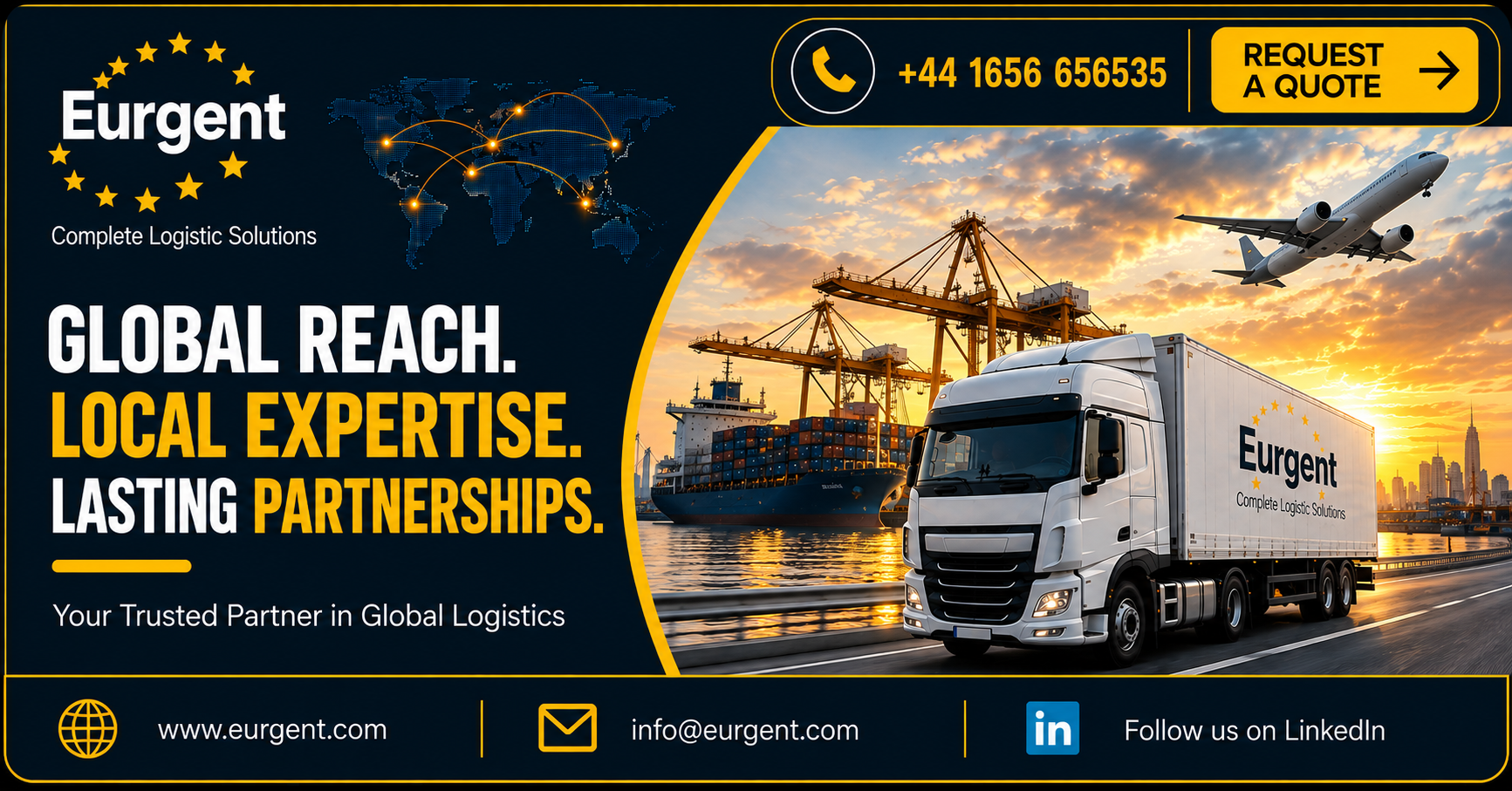
Modern businesses operate in an increasingly connected world. Suppliers may be based in one country, production facilities in another, and customers spread across multiple markets. Moving goods successfully between these locations requires much more than simply arranging transport. It requires reliable coordination, local knowledge, international capability and strong relationships throughout the supply chain.
At Eurgent, our approach to complete logistic solutions is built around three important principles: global reach, local expertise and lasting partnerships. By bringing these elements together, businesses can gain a logistics partner capable of supporting both everyday transport requirements and the challenges that come with increasingly complex supply chains.
Whether goods need to move by road, air or sea, effective logistics depends on understanding the entire journey. From planning and coordination to communication and delivery, every stage matters.
Why Global Logistics Requires More Than Transportation
It is easy to think of logistics as simply moving freight from point A to point B. In reality, successful logistics management involves a much broader range of considerations.
Businesses may need to coordinate suppliers, transport providers, warehouses, ports, airports and delivery locations. International movements can introduce additional considerations including different transport networks, documentation requirements, schedules and operational procedures.
A well-managed logistics operation therefore requires visibility and coordination across the complete movement of goods.
Depending on the shipment and destination, this can include:
- Road freight and distribution
- Air freight solutions
- Sea freight and container movements
- International freight coordination
- Time-sensitive deliveries
- Supply chain planning
- Collection and final-mile delivery coordination
- Communication between multiple logistics partners
The objective is not simply to find a method of transport. It is to create a practical logistics solution that supports the customer’s operational requirements.
Global Reach: Connecting Businesses Across Markets
International trade has created enormous opportunities for businesses, but it has also made supply chains more interconnected. A delay in one part of the world can affect manufacturing, inventory availability and customer deliveries elsewhere.
Global logistics capability helps businesses coordinate freight across these interconnected networks.
Depending on the nature of the shipment, different modes of transport may be appropriate. Sea freight can provide an effective solution for substantial international cargo movements, while air freight can be valuable when speed is particularly important. Road transport remains essential for domestic distribution and for connecting businesses with ports, airports, warehouses and final destinations.
For many supply chains, the most effective solution involves more than one transport mode.
Road Freight
Road freight provides flexibility and direct connectivity between locations. It plays an essential role in domestic distribution as well as international logistics, where trucks frequently connect warehouses and businesses with ports, airports and distribution centres.
Reliable road transport can help businesses maintain delivery schedules, replenish inventory and keep supply chains moving efficiently.
Air Freight
When transit time is a major consideration, air freight can provide a valuable option for international shipments.
Businesses may consider air freight for urgent goods, high-value products, important components or shipments where delays could significantly affect operations.
Effective air freight coordination requires careful planning before and after the flight itself. Collection, airport handling and onward transportation all contribute to the overall journey.
Sea Freight
Sea freight remains fundamental to global commerce, particularly when businesses need to transport larger volumes of goods internationally.
Container shipping connects major commercial markets and can provide an efficient solution for many types of cargo. However, successful sea freight also depends on coordinating inland transportation, port operations and final delivery.
This is why international logistics should be considered as a complete journey rather than a series of unrelated transport movements.
Local Expertise Makes Global Logistics Work
A global network is valuable, but international coverage alone does not guarantee effective logistics.
Local expertise provides the practical understanding required to manage freight successfully within individual markets and transport networks.
Every location can present different operational challenges. Transport infrastructure, delivery environments, local procedures and available routes can vary significantly. Understanding these conditions can help logistics providers identify practical solutions and respond more effectively when circumstances change.
Local knowledge can support better decisions regarding:
- Collection and delivery planning
- Suitable transport options
- Route selection
- Local distribution requirements
- Connections with ports and airports
- Operational scheduling
- Alternative solutions when disruption occurs
The combination of international capability and local knowledge can therefore provide businesses with a more connected logistics service.
The Importance of Strong Logistics Partnerships
Freight transportation is ultimately a relationship-driven industry. Technology, vehicles and global networks are important, but businesses also need logistics providers they can communicate with and rely upon.
A strong logistics partnership develops when the provider understands more than the details of an individual shipment. Over time, they can develop a better understanding of the customer’s supply chain, priorities, delivery expectations and operational challenges.
This knowledge can make future logistics planning more effective.
Instead of repeatedly treating every shipment as an isolated transaction, a long-term logistics relationship can focus on consistency, communication and continuous improvement.
Communication Creates Confidence
Businesses need to know what is happening with their freight. Clear communication helps logistics teams, suppliers and customers coordinate their own activities around expected movements.
Good communication becomes particularly important when circumstances change. Transport networks can be affected by congestion, weather, capacity constraints and other operational issues. When challenges arise, timely information enables businesses to make informed decisions.
Understanding the Customer’s Priorities
Not every shipment has the same requirements.
For one customer, the main priority may be speed. Another may need to manage large volumes of freight efficiently. A different business may require a flexible solution because its shipping requirements regularly change.
A logistics provider that understands these priorities can focus on finding an appropriate solution rather than applying the same approach to every movement.
How Integrated Logistics Can Simplify Complex Supply Chains
Complex supply chains often involve numerous organisations. Manufacturers, suppliers, carriers, warehouses and distribution partners may all contribute to a single product’s journey.
Without effective coordination, this complexity can create fragmented communication and unnecessary administrative work.
An integrated logistics approach aims to connect the different stages of the journey.
For example, an international shipment may require:
- Collection from the supplier
- Transportation to the departure port or airport
- International freight movement
- Arrival and onward coordination
- Road transportation to a warehouse or distribution facility
- Final delivery to the required destination
Managing these stages as part of one coordinated logistics strategy can provide greater clarity and help businesses maintain better oversight of their freight movements.
Choosing the Right Transport Mode
There is no single transportation method that is right for every shipment. The appropriate solution depends on the specific requirements of the goods and the business.
| Transport Mode | Typical Considerations | Common Applications |
|---|---|---|
| Road Freight | Flexibility, direct delivery and regional connectivity | Domestic and European distribution, collections and onward transport |
| Air Freight | Speed and time sensitivity | Urgent, valuable or time-critical international shipments |
| Sea Freight | Volume, international distance and shipment planning | Containerised and larger-volume international cargo |
| Multimodal Logistics | Combining different transport modes | Complex international supply chains requiring coordinated movement |
The decision should consider the complete shipment rather than one factor in isolation. Transit requirements, destination, cargo characteristics, operational priorities and onward transportation can all influence the most suitable approach.
Why Reliability Matters in Supply Chain Management
Logistics has a direct impact on wider business performance.
When materials arrive as planned, production can continue. When inventory reaches warehouses at the expected time, businesses can maintain availability. When finished goods are delivered reliably, companies are better positioned to meet customer expectations.
Conversely, logistics disruption can affect multiple parts of an organisation.
Potential consequences may include:
- Production interruptions
- Inventory shortages
- Missed delivery commitments
- Additional storage or transport requirements
- Administrative pressure on internal teams
- Reduced customer satisfaction
For this reason, logistics should not be viewed simply as an operational expense. Effective freight and supply chain management can contribute to the reliability and resilience of the wider business.
Building More Resilient Supply Chains
Modern supply chains must be capable of adapting when conditions change. Businesses cannot prevent every disruption, but thoughtful logistics planning can make it easier to respond.
Supply chain resilience starts with understanding where potential problems could occur and considering realistic alternatives.
This may involve evaluating different routes, transport modes, suppliers or distribution arrangements. It can also mean improving communication so that problems are identified early enough for alternative plans to be considered.
Flexibility Is Essential
A transport solution that works perfectly today may not always be the best option tomorrow. Shipment volumes can change, customer requirements can evolve and international transport conditions can fluctuate.
Flexible logistics support allows businesses to adapt their transportation strategy as circumstances change.
Visibility Supports Better Decisions
Businesses make better operational decisions when they have clear information about their supply chain.
Knowing the status of important shipments can help teams plan inventory, production schedules, warehouse operations and customer deliveries more effectively.
Communication and visibility should therefore be central parts of a strong logistics relationship.
Global Capability With a Personal Approach
One of the challenges for businesses operating internationally is finding the right balance between scale and service.
Global logistics requires extensive connections and the ability to coordinate freight across different regions. At the same time, customers often benefit from dealing with people who understand their individual requirements.
This is where the combination of global reach and local expertise becomes particularly valuable.
Businesses can access international transport solutions while maintaining the communication and practical support needed to manage individual shipments effectively.
Why Long-Term Logistics Relationships Matter
Long-term partnerships can create value because logistics providers gain a deeper understanding of the businesses they support.
With greater familiarity comes better context. A logistics partner can understand which shipments are particularly time-sensitive, how delivery schedules affect operations and where flexibility may be required.
Over time, this can support more proactive logistics planning.
Strong partnerships are built through consistent service, transparent communication and a willingness to find practical solutions when requirements change.
That relationship-focused approach is particularly important in international logistics, where multiple parties may need to work together to complete a single shipment successfully.
Eurgent: Complete Logistic Solutions
Eurgent understands that businesses need more than transportation. They need logistics support capable of connecting international reach with practical expertise and dependable communication.
Our focus on complete logistic solutions reflects the interconnected nature of modern supply chains. Road, air and sea transportation can each form part of a wider logistics strategy designed around the needs of the shipment and the business behind it.
Whether you are coordinating international freight, managing regular distribution or exploring logistics solutions for changing supply chain requirements, working with an experienced logistics partner can simplify the process.
Our philosophy is straightforward:
Global Reach. Local Expertise. Lasting Partnerships.
Frequently Asked Questions About Global Logistics
What is global logistics?
Global logistics is the planning, coordination and movement of goods between locations in different countries or regions. It can involve road, air and sea transportation as well as warehousing, distribution and coordination between different supply chain partners.
Why is local expertise important in international logistics?
Local expertise helps logistics providers understand the practical requirements of individual markets and transport networks. This knowledge can support route planning, collections, deliveries and coordination with local infrastructure such as ports and airports.
What is a complete logistics solution?
A complete logistics solution considers the broader journey of a shipment rather than focusing only on one transport movement. Depending on the requirement, this may involve coordinating collection, international freight, onward transportation and final delivery.
When should a business consider air freight?
Air freight may be appropriate when transit time is particularly important. It can be useful for urgent shipments, valuable goods, important components and other cargo where faster international transportation is a priority.
When is sea freight commonly used?
Sea freight is commonly considered for international cargo movements, particularly where businesses are transporting containers or larger volumes of goods. The suitability of sea freight depends on factors including destination, shipment requirements and required transit times.
Why is road freight important to international supply chains?
Road transport frequently connects the other stages of an international shipment. Trucks can move goods between suppliers, warehouses, ports, airports, distribution centres and final delivery locations, making road freight an important part of many multimodal supply chains.
What is multimodal logistics?
Multimodal logistics involves using more than one form of transport to complete a shipment. For example, goods might travel by road to a port, continue internationally by sea and then return to road transport for final delivery.
How can a logistics partner support supply chain resilience?
A logistics partner can help businesses consider alternative transport options, coordinate different stages of freight movements and maintain communication when circumstances change. Having access to multiple logistics solutions can provide additional flexibility when disruptions occur.
Build a Stronger Logistics Partnership With Eurgent
Global supply chains may be complex, but managing freight does not need to feel fragmented. The right logistics relationship brings together international capability, practical knowledge and dependable communication.
At Eurgent, we believe successful logistics is built not only on moving goods, but on building relationships that help businesses keep moving forward.
Looking for a trusted logistics partner?
Talk to Eurgent about your freight and logistics requirements and discover how our complete logistic solutions can support your business.
Call: +44 1656 656535
Email: info@eurgent.com
Website: www.eurgent.com
Global Reach. Local Expertise. Lasting Partnerships.