


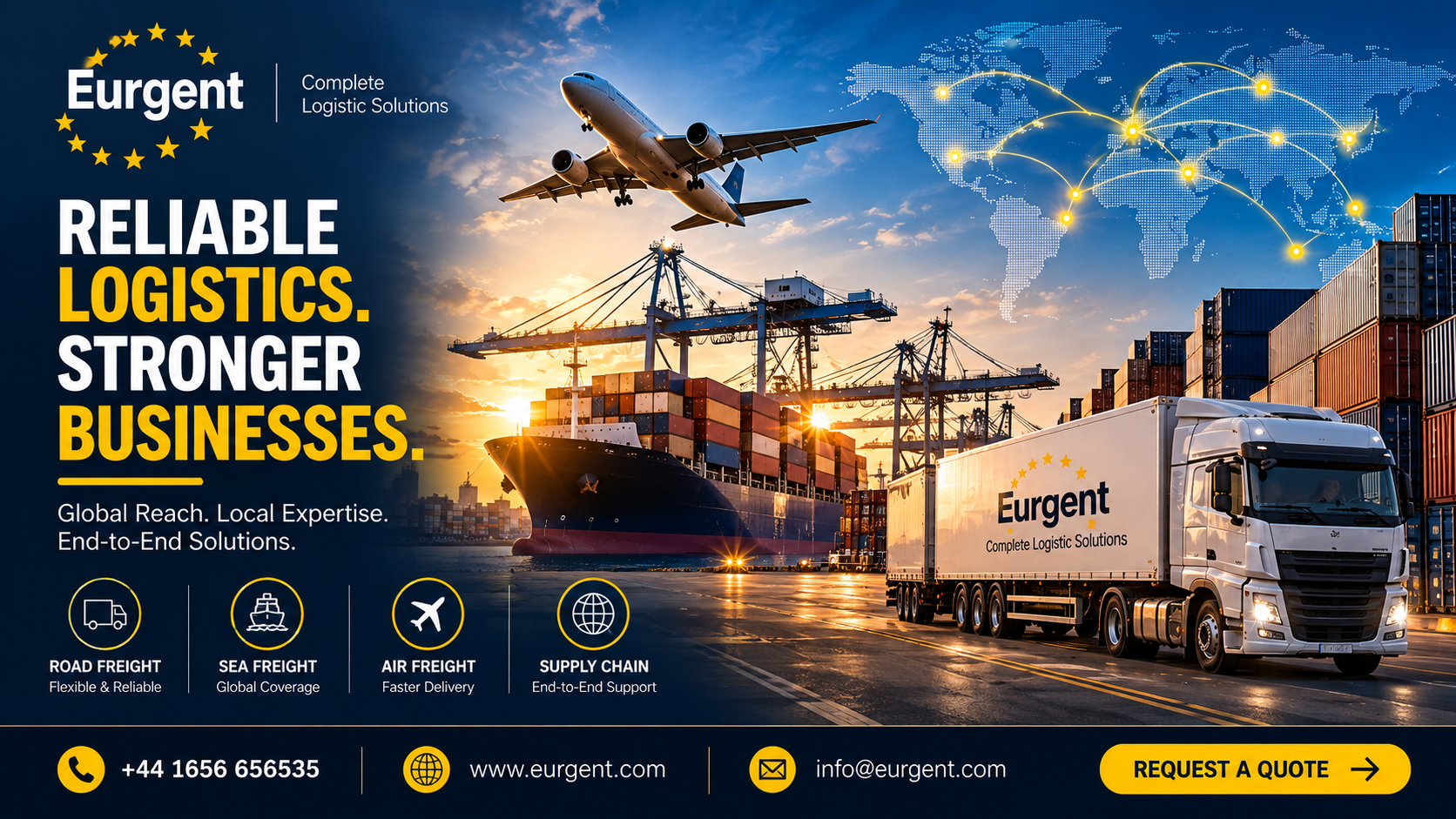
Reliable logistics is more than moving goods from one location to another. It is about keeping supply chains connected, deliveries coordinated and businesses moving forward with confidence.
Whether cargo travels by road, sea or air, every shipment depends on careful planning, clear communication and effective coordination. When these elements work together, logistics becomes more than an operational requirement—it becomes an important part of business performance.
For Eurgent Complete Logistic Solutions, the focus is simple: Reliable Logistics. Stronger Businesses. Through road freight, sea freight, air freight and wider supply-chain support, businesses can build logistics operations designed around their actual requirements.
Why Reliable Logistics Matters to Business Success
Almost every product-based business depends on logistics in some form. Raw materials need to reach production facilities. Finished products need to reach warehouses, distributors, retailers or customers. International shipments may need to pass through several transport networks before arriving at their final destination.
If one important stage fails, the impact can extend far beyond the shipment itself.
Unreliable logistics can contribute to:
- Missed delivery deadlines
- Production interruptions
- Inventory shortages
- Additional operational costs
- Poor customer experiences
- Pressure on internal teams
- Reduced supply-chain visibility
- Difficulty planning future operations
Reliable logistics helps businesses create greater consistency across these movements. When companies understand how goods will move, who is coordinating each stage and what is happening during transit, they can make better-informed decisions.
Logistics Is a Connected Journey
A shipment may appear straightforward from the customer’s perspective: collect the goods and deliver them to the destination.
Behind that journey, however, there can be multiple stages.
A typical international movement could involve:
Collection → Origin Handling → Main Transport → Destination Handling → Final Delivery.
Depending on the requirement, different organisations, facilities and transport modes may be involved at each stage.
This is why effective logistics requires more than booking transportation. The individual parts of the journey need to work together.
Road Freight: Flexible Transport for Connected Supply Chains
Road freight is a fundamental part of modern logistics. It can provide direct transportation between businesses while also connecting warehouses, ports, airports and distribution centres.
Road transport can support:
- Domestic deliveries
- International road movements
- Collection and delivery services
- Port and airport connections
- Distribution requirements
- Time-sensitive movements
- Multimodal logistics operations
One of the major strengths of road freight is flexibility. Unlike transport modes that depend on fixed terminals, road vehicles can often connect directly with collection and delivery locations.
That makes road transport particularly important at the beginning and end of wider international logistics journeys.
Sea Freight: Connecting Businesses With Global Markets
Sea freight plays an essential role in international trade, allowing large volumes of goods to move between markets around the world.
For many businesses, sea transportation can form the backbone of an international supply chain.
However, arranging sea freight involves more than selecting a vessel.
Successful coordination may require consideration of:
- Origin collection
- Container requirements
- Port operations
- Sailing schedules
- Cargo documentation
- Destination arrangements
- Onward transportation
- Final delivery
Each stage needs to connect effectively with the next.
Good planning therefore considers the complete door-to-door journey rather than treating the ocean movement as an isolated part of the shipment.
Air Freight: Supporting Time-Critical Logistics
When transit time is particularly important, air freight can provide an effective option for moving goods over long distances.
Air transportation may be suitable for urgent, valuable or time-sensitive shipments where speed is an important operational consideration.
But faster transportation still requires careful planning.
Businesses need to consider:
- Cargo characteristics
- Weight and dimensions
- Available routes
- Flight schedules
- Handling requirements
- Documentation
- Origin transportation
- Destination delivery
The most effective air freight solution is therefore not simply about getting cargo onto an aircraft. It is about coordinating the entire movement efficiently.
Road, Sea or Air: Which Freight Solution Is Right?
There is no universal answer because every shipment has different requirements.
The right freight option depends on factors such as urgency, destination, cargo type, shipment size, operational priorities and the wider supply chain.
| Transport Mode | Typical Considerations | Role in the Supply Chain |
|---|---|---|
| Road Freight | Flexibility, accessibility and direct connections | Domestic movements, collections, deliveries and multimodal connections |
| Sea Freight | International movements and larger cargo volumes | Connecting global markets through maritime networks |
| Air Freight | Speed and time-sensitive requirements | Supporting urgent and long-distance international movements |
Some shipments may use only one mode. Others may require a combination of road, sea and air transportation.
The important point is to select a solution around the actual business requirement rather than automatically choosing the same method for every movement.
Multimodal Logistics Creates End-to-End Connections
International logistics often requires several transport modes.
For example, cargo may travel:
Warehouse → Truck → Port → Vessel → Port → Truck → Customer.
Another urgent international movement could involve:
Supplier → Road Collection → Airport → Aircraft → Destination Airport → Final-Mile Delivery.
These journeys demonstrate why logistics coordination matters.
Each individual transport stage might operate successfully, but the complete shipment can still encounter problems if the connections between those stages are poorly managed.
Effective multimodal logistics focuses on the complete journey.
End-to-End Logistics Simplifies Complex Movements
As supply chains become more complex, businesses can find themselves coordinating multiple carriers, facilities and contacts for a single shipment.
An end-to-end logistics approach aims to create greater continuity across the movement.
This may include coordination from initial collection through to final delivery, with the different stages considered as parts of one logistics requirement.
Benefits can include:
- Clearer communication
- More coordinated planning
- Better understanding of shipment progress
- Fewer disconnected handovers
- Simpler operational management
- Greater visibility across the journey
For busy businesses, reducing unnecessary logistics complexity can also allow internal teams to focus more attention on their core operations.
Global Reach, Local Expertise
International logistics requires global connections, but individual shipments still depend heavily on local operations.
Cargo moves through specific roads, warehouses, ports, airports and distribution facilities. Local conditions and operational requirements can influence each stage.
This makes the combination of global reach and local expertise particularly valuable.
Global reach helps connect different markets and transport networks. Local expertise helps support the practical execution of individual stages.
When the two work together, businesses can approach international logistics with greater coordination.
Reliable Logistics Begins With Good Planning
A reliable shipment starts before the cargo begins moving.
Effective planning means understanding the requirement clearly and identifying the factors that could influence the journey.
Before arranging transportation, useful questions include:
- What goods are being transported?
- What are the dimensions and weight?
- Where will the goods be collected?
- Where is the final destination?
- When will the cargo be ready?
- Is there a required delivery date?
- Are there special handling requirements?
- Which transport mode is appropriate?
- Will multiple transport modes be required?
- What documentation is needed?
Understanding these details early can support better transport planning and reduce avoidable complications later in the journey.
Supply Chain Visibility Supports Better Decisions
Businesses need more than physical transportation. They also need information.
Knowing what is happening with an important shipment can help teams coordinate inventory, production, customer communication and other operational activities.
Useful logistics visibility can help answer questions such as:
- Has the shipment been collected?
- Has it reached the next stage?
- Is the movement progressing according to plan?
- Has anything changed?
- Does somebody need to take action?
- When is delivery expected?
Visibility becomes especially valuable when circumstances change because businesses can respond more effectively when they receive useful information at the right time.
Communication Is Part of Reliable Logistics
Strong logistics is built on both movement and communication.
Customers, carriers, warehouses and operational teams may all need information at different points in a shipment journey.
Clear communication helps these parties coordinate responsibilities and understand what is happening.
When an unexpected event occurs, communication becomes even more important.
The objective should not simply be to identify that something has changed. It should be to understand the situation, communicate appropriately and determine the next practical action.
Building Resilience Into the Supply Chain
Supply chains operate in real-world conditions, which means unexpected changes can occur.
Transport schedules may change. Routes can become congested. Capacity may become limited. Operational or weather conditions can affect planned movements.
Businesses cannot eliminate every source of uncertainty, but they can improve preparedness.
Supply-chain resilience can be strengthened by:
- Identifying critical shipments
- Understanding important dependencies
- Considering alternative routes where appropriate
- Maintaining useful shipment visibility
- Establishing clear communication processes
- Working with experienced logistics partners
- Reviewing previous movements and recurring challenges
Resilience is not about predicting every possible disruption. It is about creating the capability to respond more effectively when circumstances change.
How Reliable Logistics Supports Customer Experience
Logistics often happens behind the scenes, but customers can experience its results directly.
If products arrive when expected and communication is clear, the logistics operation may feel almost invisible.
When shipments are delayed or information is unavailable, however, logistics quickly becomes part of the customer’s experience with the business.
Reliable logistics can therefore support:
- More consistent delivery experiences
- Better customer communication
- Greater confidence when setting expectations
- Stronger long-term business relationships
For companies competing on service as well as product quality, logistics can become an important part of the overall customer proposition.
Reliable Logistics Supports Business Growth
As a business grows, its logistics requirements often grow with it.
Additional customers may mean higher shipment volumes. New markets may create international transport requirements. New suppliers may introduce different routes and handling needs.
A scalable logistics strategy considers how these requirements may develop.
Businesses planning for growth can consider:
- Future shipment volumes
- New geographic markets
- Additional transport requirements
- Warehouse and distribution needs
- Supply-chain visibility
- Operational resilience
- Long-term logistics partnerships
When logistics develops alongside the business, it can support growth rather than becoming an operational constraint.
Stronger Logistics Partnerships Create Long-Term Value
A logistics provider should not simply appear when transportation needs to be booked.
Over time, a strong logistics relationship can create a deeper understanding of the customer’s operation.
This may include knowledge of:
- Regular shipment routes
- Typical cargo requirements
- Important delivery windows
- Recurring operational challenges
- Communication preferences
- Business priorities
This understanding can make future planning more informed and help both parties work more effectively together.
Technology and People Work Together in Modern Logistics
Digital technology can provide valuable support for modern logistics operations.
Depending on the operation, technology can assist with:
- Shipment visibility
- Transport planning
- Documentation
- Communication
- Operational reporting
- Exception identification
However, logistics remains heavily dependent on people.
Experienced professionals interpret information, communicate with different parties, make operational decisions and respond when circumstances change.
Technology provides information and tools. People provide judgement, relationships and practical coordination.
From Reactive Shipping to Proactive Logistics
Businesses sometimes approach logistics reactively: a shipment becomes urgent, transportation is arranged quickly and problems are addressed as they appear.
There will always be unexpected or urgent movements, but greater forward planning can help reduce unnecessary pressure.
A proactive approach may consider upcoming shipment volumes, capacity requirements, important deadlines and potential operational challenges in advance.
This allows logistics to become part of wider business planning instead of remaining a last-minute activity.
What Should Businesses Look for in a Logistics Partner?
The right logistics relationship depends on the needs of the business, but several qualities can be particularly important.
Range of Transport Solutions
A provider with access to road, sea and air logistics options can help businesses evaluate different approaches based on individual requirements.
Clear Communication
Businesses should understand who is managing their shipment and how important information will be communicated.
International Capability
For organisations operating across borders, the ability to coordinate international movements is essential.
Practical Expertise
Logistics requires problem-solving as well as transportation. Practical experience can become particularly valuable when a movement is complex or circumstances change.
Customer-Focused Planning
The logistics solution should reflect the actual shipment rather than forcing every requirement into the same standard approach.
Five Principles of Stronger Logistics
| Principle | Why It Matters |
|---|---|
| Plan | Understand the complete requirement before movement begins. |
| Connect | Coordinate road, sea, air and other stages of the journey. |
| Communicate | Keep relevant parties informed throughout the movement. |
| Respond | Take practical action when circumstances change. |
| Improve | Use operational experience to strengthen future logistics planning. |
How Eurgent Supports Complete Logistic Solutions
Eurgent supports businesses with logistics solutions designed to connect the different stages of cargo movement.
With road freight, sea freight, air freight and wider supply-chain support, the emphasis is on understanding each requirement and coordinating an appropriate solution around it.
This approach reflects an important reality: successful logistics is not simply about individual vehicles, vessels or aircraft. It is about how every stage works together.
From collection through to final delivery, reliable planning and coordination can help businesses maintain stronger, more connected supply chains.
Frequently Asked Questions About Reliable Logistics
What is a complete logistics solution?
A complete logistics solution considers the wider movement of goods rather than a single transport stage. Depending on the requirement, this may involve collection, road transportation, air or sea freight, handling, coordination and final delivery.
What is road freight?
Road freight is the transportation of goods by road vehicles. It can be used for domestic and international movements as well as connections between businesses, warehouses, ports and airports.
When should a business consider air freight?
Air freight can be considered when transit time is an important factor, particularly for urgent or time-sensitive international movements. Suitability depends on the specific cargo and shipment requirements.
When is sea freight suitable?
Sea freight is widely used for international cargo movements and can be particularly relevant where larger shipment volumes need to move between global markets. The right solution depends on the cargo, destination, schedule and wider supply-chain requirements.
Can a shipment use road, air and sea transportation?
Yes. Multimodal logistics combines different transport modes within one overall journey. Road transportation is frequently used to connect cargo with ports and airports before or after the main international movement.
Why is supply-chain visibility important?
Visibility gives businesses useful information about shipment progress. This can support operational planning, customer communication and faster responses when circumstances change.
What information is needed for a freight quote?
Requirements vary, but useful information typically includes the collection point, destination, cargo description, dimensions, weight, cargo-ready date, delivery requirements and any special handling considerations.
How can reliable logistics strengthen a business?
Reliable logistics can support more consistent operations, clearer planning, stronger customer experiences and better coordination across the supply chain. For growing businesses, it can also provide a stronger operational foundation for serving additional customers and markets.
Reliable Logistics. Stronger Businesses.
Behind every successful shipment is a network of planning, transportation, communication and coordination.
When these elements work effectively together, logistics can do more than deliver cargo. It can help businesses operate with greater confidence, serve customers more consistently and connect with markets around the world.
Whether the requirement involves road freight, sea freight, air freight or an end-to-end logistics solution, the objective remains the same: understand the journey, coordinate the details and keep goods moving.
Global reach. Local expertise. End-to-end solutions.
Request a Logistics Quote
Need support with your next road, sea or air freight movement? Contact Eurgent Complete Logistic Solutions to discuss your requirements and explore the right logistics solution for your business.
Phone: +44 1656 656535
Website: www.eurgent.com
Email: info@eurgent.com
Reliable Logistics. Stronger Businesses.