


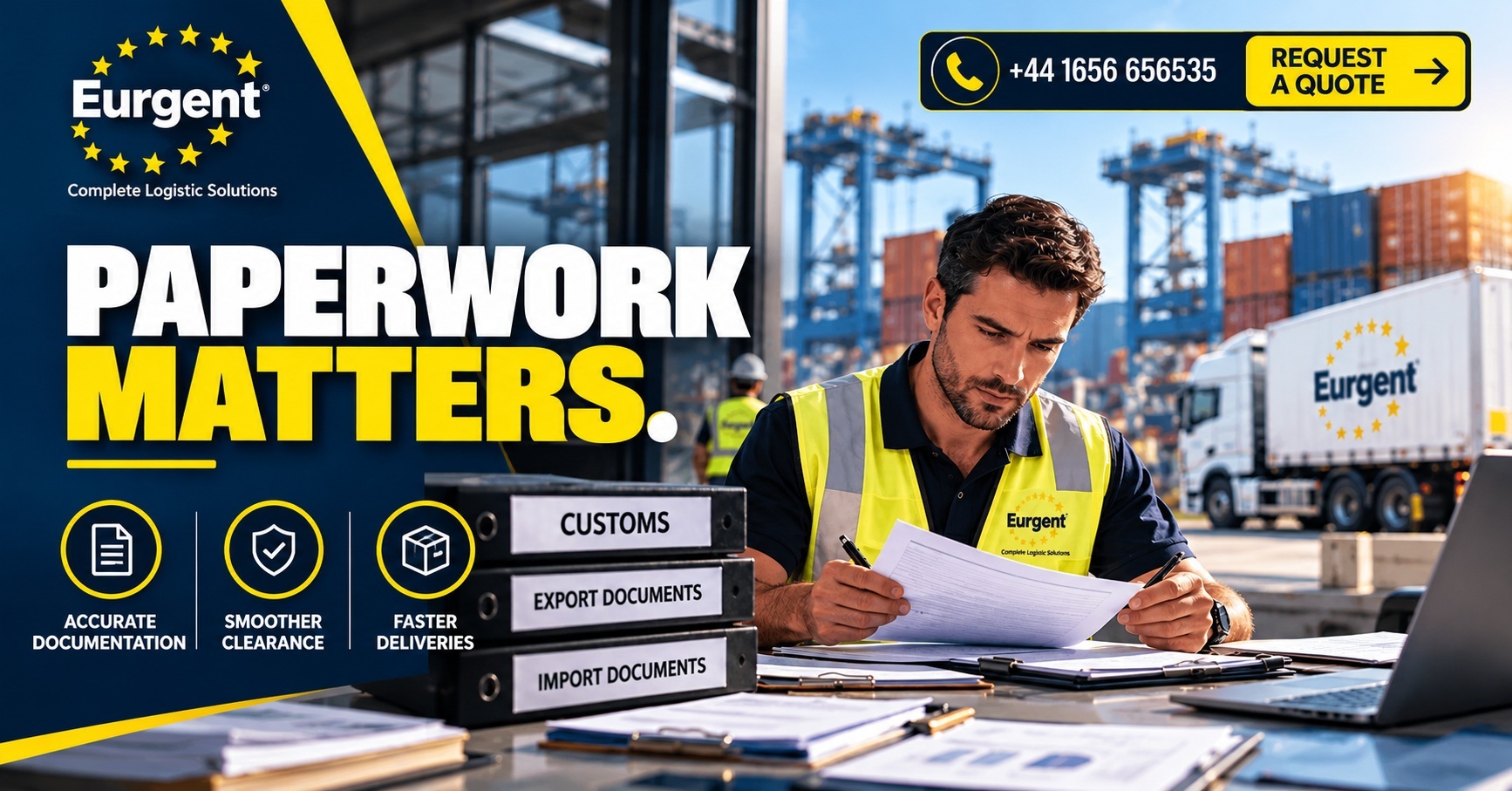
When businesses think about logistics, they often focus on vehicles, warehouses, shipping containers and delivery schedules. Yet behind every successful international shipment is something equally important: accurate documentation.
Shipping goods across borders involves more than moving cargo from one location to another. Businesses must provide information about what is being transported, where it is going, who is responsible for the shipment and whether it meets applicable customs and regulatory requirements.
Even a relatively small documentation error can create complications. Incorrect product descriptions, missing commercial invoices or inconsistent shipment details may result in customs queries, additional inspections, unexpected costs or delivery delays.
For businesses that depend on reliable supply chains, these disruptions can affect customer relationships, operational efficiency and profitability.
Understanding logistics paperwork is therefore essential for importers, exporters and businesses involved in international trade.
This guide explains why shipping documentation matters, which documents are commonly required and how businesses can improve documentation accuracy to support smoother customs clearance and more efficient deliveries.
What Is Logistics Documentation?
Logistics documentation refers to the records, forms and supporting information used to manage the transportation, handling, customs clearance and delivery of goods.
These documents provide essential information to the parties involved in a shipment, including exporters, importers, freight forwarders, transport providers, customs authorities and other relevant organisations.
Depending on the shipment, documentation may establish:
- The identity of the exporter and importer.
- The nature, quantity and value of the goods.
- The country of origin and destination.
- The agreed commercial terms.
- The transport arrangements.
- The customs classification of the goods.
- Applicable licences, permits or certificates.
- Evidence of shipment, receipt or delivery.
The exact documents required depend on several factors, including the countries involved, transport method, type of goods and applicable regulations.
Accurate documentation helps ensure that everyone involved in the supply chain is working with consistent and reliable information.
Why Accurate Shipping Documentation Is Important
Shipping paperwork is not simply an administrative requirement. It supports several essential functions within international logistics.
1. It Supports Customs Clearance
Customs authorities use shipment documentation to assess goods entering or leaving a country.
They may examine information relating to product descriptions, customs values, tariff classifications, origin and applicable import or export restrictions.
If the documentation is incomplete or inconsistent, customs authorities may request clarification, supporting evidence or additional checks before releasing the goods.
Accurate information helps customs declarations reflect the actual shipment and can reduce avoidable clearance complications.
2. It Helps Prevent Shipping Delays
International shipments frequently involve multiple organisations and transport stages.
Goods may move between warehouses, ports, airports, customs facilities and final delivery locations.
Documentation problems discovered during these transitions can interrupt the movement of cargo.
For example, a mismatch between the commercial invoice and packing list may require investigation before the shipment can proceed.
Preparing and reviewing documents before dispatch helps businesses identify potential problems earlier.
3. It Reduces the Risk of Unexpected Costs
Documentation errors can create additional expenses.
Depending on the circumstances, these may include:
- Storage charges while goods await clearance.
- Demurrage or detention charges where applicable.
- Administrative fees for correcting documentation.
- Additional inspection or handling costs.
- Transport rescheduling expenses.
- Costs associated with missed delivery commitments.
Not every documentation error results in additional charges. However, preventing avoidable mistakes can reduce financial exposure.
4. It Supports Regulatory Compliance
International trade is governed by customs laws, product-specific requirements and other regulations.
Businesses may need to demonstrate that their goods meet applicable import or export conditions.
For certain products, additional documentation may be required to establish safety, origin, quality or regulatory approval.
Accurate records help businesses meet their obligations and respond to questions from relevant authorities.
5. It Improves Supply Chain Coordination
Logistics depends on effective communication between multiple parties.
Transport providers need accurate collection and delivery information. Customs representatives require shipment details. Warehouse teams need to understand the quantity and nature of incoming goods.
Consistent documentation reduces confusion and supports better coordination throughout the shipment process.
Essential Documents Used in International Shipping
Different shipments require different paperwork. However, several documents are commonly used in international trade.
Commercial Invoice
A commercial invoice is one of the most important documents in international shipping.
It provides information about the commercial transaction between the seller and buyer.
A commercial invoice commonly includes:
- Seller and buyer details.
- Invoice number and date.
- Description of the goods.
- Quantity and unit price.
- Total invoice value and currency.
- Agreed Incoterms rule, where applicable.
- Country of origin information, where required.
Customs authorities may use commercial invoice information when assessing the declared value of imported goods.
Businesses should ensure that descriptions and values are accurate and consistent with the underlying transaction.
Packing List
A packing list provides information about how goods are packed for transportation.
It may include package quantities, dimensions, weights, marks and identifying references.
Unlike a commercial invoice, which focuses on the commercial transaction, a packing list primarily describes the physical shipment.
This information assists transport providers, warehouse teams and customs officials when identifying and handling cargo.
For example, if a shipment contains several pallets with different products, the packing list helps identify which goods are packed in each unit.
Bill of Lading
A bill of lading is commonly used in maritime shipping.
Depending on its form and terms, it may serve as evidence of the contract of carriage, a receipt for goods and a document of title.
It typically includes information such as:
- Shipper details.
- Consignee details.
- Notify party information, where applicable.
- Port of loading.
- Port of discharge.
- Description of cargo.
- Package quantities and weight.
- Container information, where applicable.
Businesses should understand the type of bill of lading being used and the requirements for releasing the cargo.
Air Waybill
An air waybill is used for cargo transported by air.
It provides information about the shipment and serves as evidence of the air carriage contract and receipt of the goods.
Unlike a negotiable ocean bill of lading, an air waybill is generally not a negotiable document of title.
Accurate air waybill information supports cargo identification, tracking and coordination between the parties involved in air transport.
Certificate of Origin
A certificate of origin provides information about the country in which goods originate under the relevant origin rules.
Origin can influence customs treatment, trade restrictions and eligibility for preferential tariff arrangements.
Some trade agreements require specific forms of origin certification or declarations before preferential treatment can be claimed.
Businesses should not assume that the country from which goods are shipped is necessarily their country of origin.
Origin must be determined according to the applicable rules.
Customs Declaration
A customs declaration provides information required by customs authorities for the import or export of goods.
Depending on the jurisdiction and customs procedure, it may include:
- Importer or exporter identification.
- Commodity classification.
- Customs value.
- Country of origin.
- Applicable customs procedure.
- Transport and shipment details.
- Supporting document references.
Customs declarations must accurately reflect the goods and comply with the requirements of the relevant customs authority.
Import and Export Licences
Certain goods are subject to licensing or permit requirements.
These may apply to specific product categories, controlled goods or transactions involving particular destinations.
Businesses should establish whether licences or permits are required before arranging shipment.
Attempting to transport restricted goods without the necessary authorisation can result in serious complications.
Insurance Certificate
Where cargo insurance is arranged, an insurance certificate or other evidence of cover may be required.
It provides information about the insurance protection applicable to the shipment.
Insurance responsibilities may depend on the sales agreement, transport arrangements and applicable Incoterms rule.
Businesses should understand what risks are covered and whether any exclusions or limitations apply.
Common Shipping Documentation Mistakes
Many documentation problems arise from preventable administrative errors.
Understanding these mistakes can help businesses improve their shipping processes.
Incorrect Product Descriptions
Vague or inaccurate product descriptions can make it difficult to identify goods correctly.
Descriptions should provide sufficient detail to support identification and customs classification.
For example, describing goods simply as “equipment” may be insufficient when a more specific description is required.
Inconsistent Shipment Information
Information should be consistent across related documents.
Differences in quantities, weights, consignee details or product descriptions may lead to questions and delays.
Businesses should compare documents before submission to identify discrepancies.
Incorrect Commodity Classification
Goods traded internationally are classified using commodity codes based on the Harmonized System and relevant national tariff schedules.
Incorrect classification may affect duties, taxes, restrictions and reporting requirements.
Businesses should ensure that the classification used is appropriate for the goods and the importing or exporting jurisdiction.
Missing Supporting Documents
Some shipments require certificates, licences, permits or other supporting records.
Failing to obtain these documents before dispatch can create clearance problems.
Documentation requirements should therefore be confirmed during shipment planning.
Incorrect Commercial Values
Commercial invoices and customs declarations must reflect the appropriate values under the applicable rules.
Errors in valuation can affect duty calculations and may result in additional scrutiny.
Businesses should maintain supporting records and ensure that declared information is accurate.
Late Document Submission
Some transport and customs procedures require information to be submitted before cargo arrives or departs.
Late submissions can disrupt planned movements and clearance arrangements.
Businesses should establish document preparation deadlines and communicate them to everyone involved.
How Documentation Errors Affect Customs Clearance
Customs clearance is an essential stage of international trade.
Before goods can be released, customs authorities may need to verify the information supplied and determine whether applicable requirements have been satisfied.
When documentation is inaccurate, the clearance process may become more complicated.
Additional Customs Queries
Authorities may request clarification about the goods, their value, origin or classification.
Responding to these queries can require additional communication and supporting evidence.
Physical Cargo Inspections
Some shipments are selected for physical inspection as part of normal customs controls.
Documentation inconsistencies may also lead to additional checks, depending on the circumstances.
Inspections can affect clearance timelines and may require coordination with transport or warehouse operators.
Delayed Cargo Release
If required information is missing or unresolved, goods may remain under customs control until the relevant requirements are satisfied.
This can affect delivery schedules and create additional operational costs.
Compliance Consequences
Serious inaccuracies or failures to comply with customs requirements may result in penalties or other enforcement action under applicable law.
The consequences depend on the jurisdiction, nature of the error and relevant legal provisions.
Businesses should treat customs documentation as an important compliance responsibility rather than a routine formality.
Import Documentation vs Export Documentation
Import and export documentation serve related but different purposes.
Export documentation supports the lawful movement of goods out of the exporting country.
Import documentation supports the entry and customs clearance of goods into the destination country.
A shipment may therefore need to satisfy requirements in both jurisdictions.
Export Documentation
Depending on the shipment, export documentation may include:
- Commercial invoice.
- Packing list.
- Export customs declaration.
- Export licences or permits.
- Transport documents.
- Origin documentation.
- Other product-specific certificates.
Import Documentation
Import documentation may include:
- Commercial invoice.
- Packing list.
- Import customs declaration.
- Transport documentation.
- Import licences or permits.
- Origin evidence.
- Product-specific compliance documentation.
The precise requirements vary by country and product.
Businesses should verify the applicable rules for each shipment rather than relying on a universal document checklist.
How to Improve Logistics Documentation Accuracy
Accurate documentation requires clear procedures, reliable information and effective communication.
Businesses can reduce avoidable errors by introducing several practical measures.
1. Create a Shipment Documentation Checklist
A checklist helps ensure that essential documents are identified before cargo is dispatched.
It should be adapted to the shipment’s destination, transport method and product requirements.
The checklist can identify the documents required, the person responsible for preparing each document and the relevant submission deadline.
2. Verify Information Before Submission
Shipment information should be reviewed for accuracy and consistency.
Important details to verify include:
- Exporter and importer names.
- Delivery addresses.
- Product descriptions.
- Package quantities.
- Gross and net weights.
- Invoice values and currency.
- Commodity classifications.
- Country of origin.
- Transport references.
Where appropriate, a second review can help identify mistakes that may have been overlooked during preparation.
3. Maintain Organised Records
Businesses should establish a reliable system for storing shipment documents.
Records should be accessible to authorised employees and retained according to applicable legal and operational requirements.
Organised documentation can make it easier to respond to customs queries, investigate shipment problems and review previous transactions.
4. Establish Clear Responsibilities
Documentation problems can arise when multiple parties assume someone else is responsible for preparing or submitting a document.
Businesses should clarify responsibilities between exporters, importers, freight forwarders, customs representatives and transport providers.
Written procedures and agreed deadlines can reduce confusion.
5. Use Digital Documentation Systems
Digital systems can support document storage, information sharing and workflow management.
Depending on the solution, they may help businesses track document status, reduce repeated data entry and maintain more consistent records.
However, digital systems do not automatically guarantee accuracy.
Information must still be verified, and electronic documents must meet applicable regulatory and commercial requirements.
6. Review Requirements Before Every Shipment
Customs and product requirements can change.
Businesses should verify relevant requirements when shipping new products, entering unfamiliar markets or responding to regulatory changes.
Even repeat shipments may require updated information or supporting documents.
The Role of Freight Forwarders in Shipping Documentation
Freight forwarders play an important role in coordinating international cargo movements.
Depending on their services and contractual responsibilities, they may assist with transport arrangements, shipment information, document coordination and communication between supply chain participants.
Some freight forwarders also provide customs-related services directly or through authorised customs representatives.
However, the legal responsibility for the accuracy of customs information may remain with the importer, exporter or other responsible party under the applicable rules.
Businesses should therefore understand the responsibilities of everyone involved.
Supporting Document Coordination
International shipments can involve several documents prepared by different organisations.
Effective coordination helps ensure that relevant information is available when required.
Identifying Potential Documentation Problems
Experienced logistics professionals may recognise common discrepancies or missing information during shipment planning.
Identifying these issues before dispatch can reduce avoidable complications.
Improving Communication
Clear communication between businesses, transport providers and customs representatives is essential when resolving documentation questions.
Reliable coordination can support more predictable shipment management.
How Accurate Documentation Supports Faster Deliveries
Delivery speed depends on several factors, including transport availability, route conditions, customs procedures and operational capacity.
Accurate documentation cannot eliminate every possible delay.
However, it can help prevent delays caused by missing, inconsistent or incorrect shipment information.
When documents are prepared correctly and submitted within the required timeframes, logistics teams can coordinate the movement of goods with greater confidence.
This supports:
- More efficient shipment preparation.
- Clearer communication between logistics partners.
- Fewer avoidable documentation queries.
- Better planning around customs procedures.
- Improved delivery schedule reliability.
- More predictable customer communication.
For businesses managing time-sensitive shipments, these improvements can be particularly valuable.
Documentation and Supply Chain Risk Management
Documentation accuracy also contributes to broader supply chain risk management.
International logistics involves commercial, operational and regulatory risks.
Businesses need reliable records to understand their responsibilities and respond effectively when problems arise.
Supporting Shipment Traceability
Transport documents, commercial records and delivery confirmations can help businesses trace the movement of goods.
Reliable records make it easier to investigate discrepancies and establish what occurred during transportation.
Managing Commercial Disputes
Documentation may provide important evidence when disagreements arise about shipment quantities, delivery conditions or contractual responsibilities.
Businesses should maintain accurate records of relevant transactions and communications.
Preparing for Audits and Compliance Reviews
Customs authorities and other relevant organisations may require businesses to produce supporting records.
Organised documentation can make compliance reviews more manageable and help businesses demonstrate how shipment information was determined.
Best Practices for Businesses Managing International Shipments
Businesses can strengthen their documentation processes by incorporating the following practices into everyday logistics operations.
- Confirm shipment requirements early. Identify customs, transport and product-specific documentation requirements before dispatch.
- Use accurate product descriptions. Ensure that documents clearly identify the goods being transported.
- Check consistency across documents. Compare invoices, packing lists, transport records and customs information.
- Verify commodity classifications. Use appropriate classifications under the relevant tariff schedule.
- Clarify responsibilities. Establish which party prepares, verifies and submits each document.
- Maintain organised records. Store shipment information securely and make it accessible to authorised personnel.
- Plan around submission deadlines. Allow sufficient time for document preparation and regulatory requirements.
- Communicate changes promptly. Inform relevant logistics partners when shipment information changes.
- Review recurring errors. Identify common documentation problems and improve internal procedures.
- Seek appropriate professional guidance. Consult qualified customs or trade specialists when requirements are unclear.
These practices help businesses approach shipping documentation systematically rather than treating paperwork as a last-minute administrative task.
Why Paperwork Should Be Part of Your Logistics Strategy
Businesses often evaluate logistics performance using delivery times, transport costs and shipment reliability.
Documentation quality should also form part of this assessment.
Repeated paperwork problems may indicate weaknesses in communication, internal processes or responsibility allocation.
By monitoring documentation errors and their consequences, businesses can identify opportunities to improve their logistics operations.
Useful performance indicators may include:
- Number of documentation errors identified before dispatch.
- Frequency of customs queries linked to documentation.
- Time required to prepare shipment documents.
- Additional costs associated with documentation corrections.
- Percentage of documents submitted within required deadlines.
- Recurring discrepancies between shipment records.
Monitoring these indicators can help businesses understand where improvements are needed.
Over time, stronger documentation processes may contribute to better operational efficiency and more predictable supply chain performance.
Eurgent: Recognising the Importance of Accurate Logistics Documentation
At Eurgent, the message is simple: paperwork matters.
International logistics depends on more than the physical movement of cargo. Documentation, communication and coordination are essential parts of the shipping process.
Whether businesses are preparing import documents, organising export paperwork or coordinating customs-related information, accuracy should remain a priority.
Taking documentation seriously helps reduce avoidable complications and supports more efficient logistics operations.
As businesses manage increasingly complex supply chains, reliable information and effective coordination remain essential to successful cargo movement.
Conclusion: Better Paperwork Supports Better Logistics
Accurate shipping documentation is an essential part of international logistics.
Commercial invoices, packing lists, transport documents, customs declarations and supporting certificates all contribute to the movement of goods across borders.
When these documents contain errors or inconsistencies, businesses may face customs queries, delivery delays, additional expenses and compliance challenges.
By establishing clear documentation procedures, verifying shipment information and coordinating effectively with logistics partners, businesses can reduce avoidable risks.
Good paperwork does not guarantee that every shipment will move without disruption. However, it removes a significant source of preventable complications.
In international trade, every document plays a role in keeping cargo moving.
Need support with your logistics requirements? Contact Eurgent to discuss your shipment needs and explore suitable logistics solutions.
Website: www.eurgent.com
Email: info@eurgent.com
Telephone: +44 1656 656535